
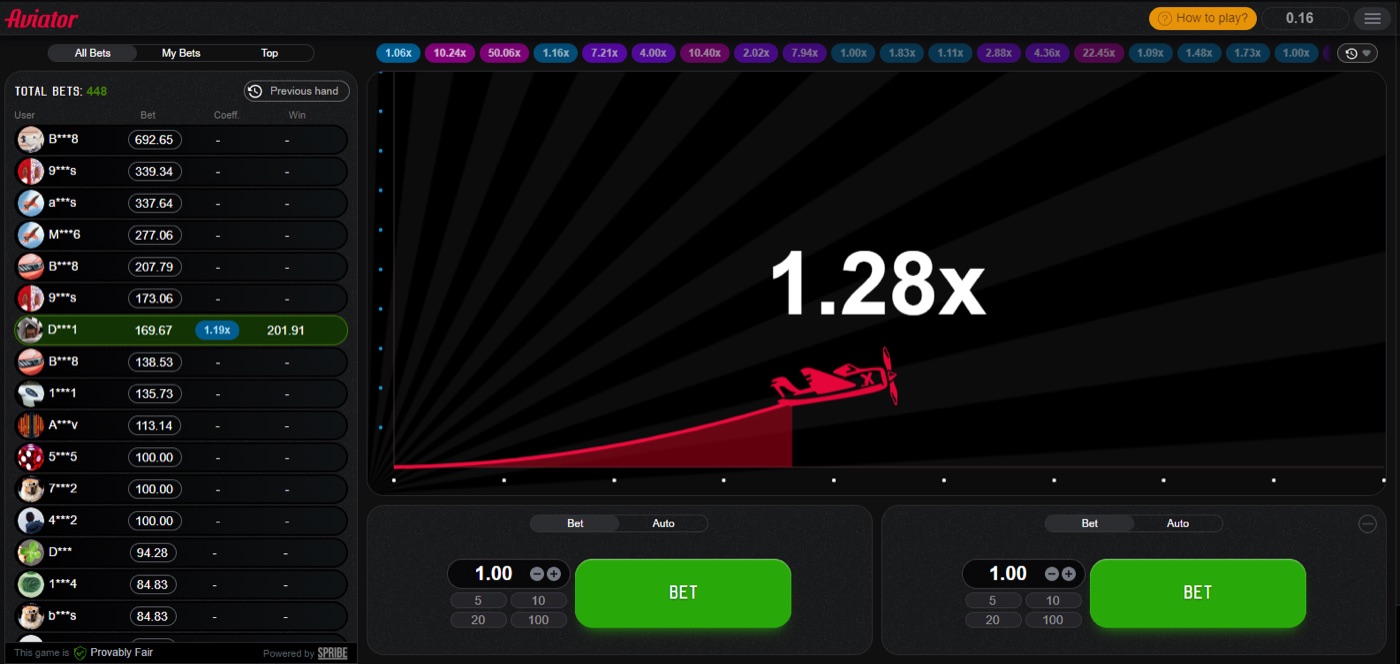
Aviator is a crash game by Spribe in which an increasing curve ends when the round crashes. The player chooses a stake, watches the multiplier rise, and tries to cash out before the crash.
A bankroll split uses separate stakes for different cash-out targets. A lower target can produce more frequent wins, while a higher target produces fewer wins and larger returns when reached. The split changes the pattern of results, but it does not remove the game’s mathematical edge.
Aviator Round Mechanism
Aviator launched in early 2019, and the first live launch took place on Adjarabet in February 2019. Spribe describes the game as a social multiplayer game with an increasing curve that can crash at any time.
Aviator has an RTP of 97% and a house edge of 3%. The crash point is fixed before take-off, and the result cannot be changed by Spribe or the operator after the round starts.
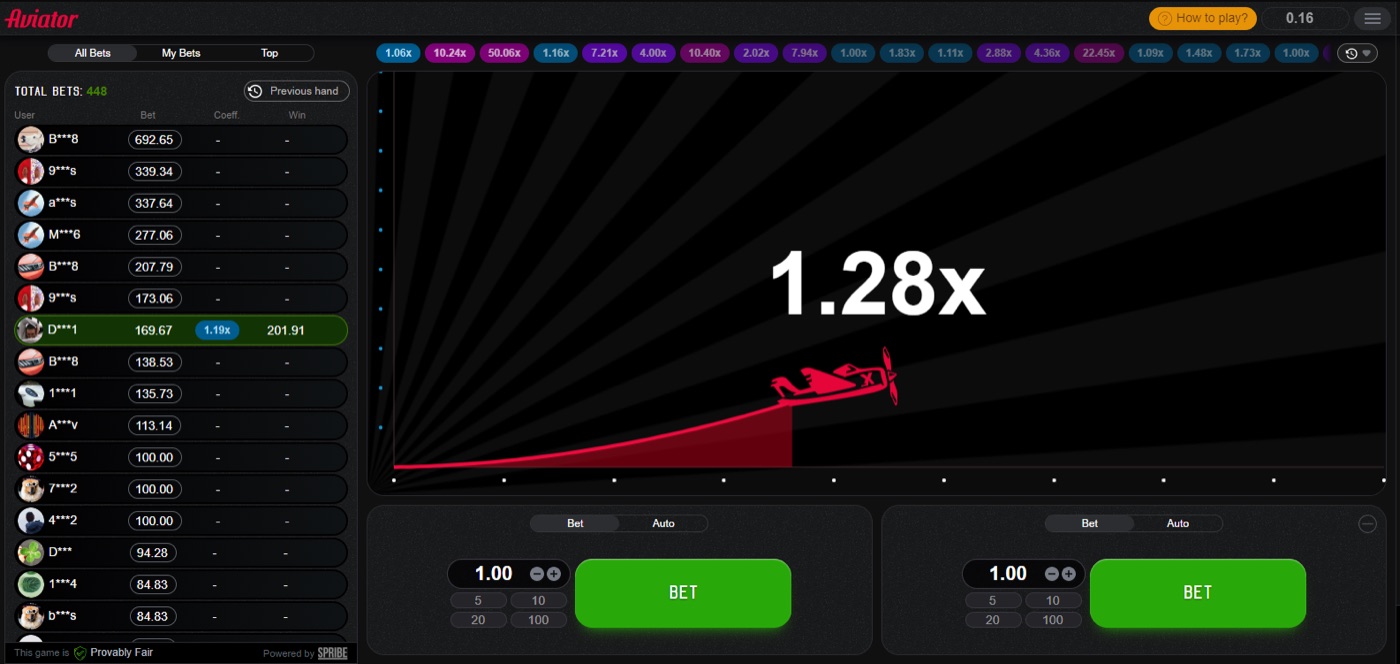
The Aviator plane rises while players choose when to cash out.
Each round normally lasts about 8-30 seconds, followed by a few seconds before the next round. Players can see previous multipliers in the round history, but earlier results do not change the probability of the next round.
- A player selects a stake before the round starts.
- The multiplier increases after take-off.
- The player cashes out manually or uses a preset auto cash-out.
- The round ends when the crash occurs.
Aviator provides two bet panels per round. The panels can use separate stakes and separate cash-out targets, which makes them suitable for a low-target and high-target split.
The game also has Bet and Auto tabs, an in-game chat, a live bets panel, a Provably Fair badge, and typical quick-stake buttons. A demo mode is available without registration through an operator demo or demo.spribe.io.
Low And High Targets
Aviator reaches 1.5x in about 64.7% of rounds and 2x in about 48.5% of rounds. Aviator reaches 5x in about 19.4% of rounds and 10x in about 9.7% of rounds.
A low target usually means a cash-out around 1.5x-2x, while a high target can mean 5x-10x or more. These labels describe the chosen multiplier, not a change in the probability model.
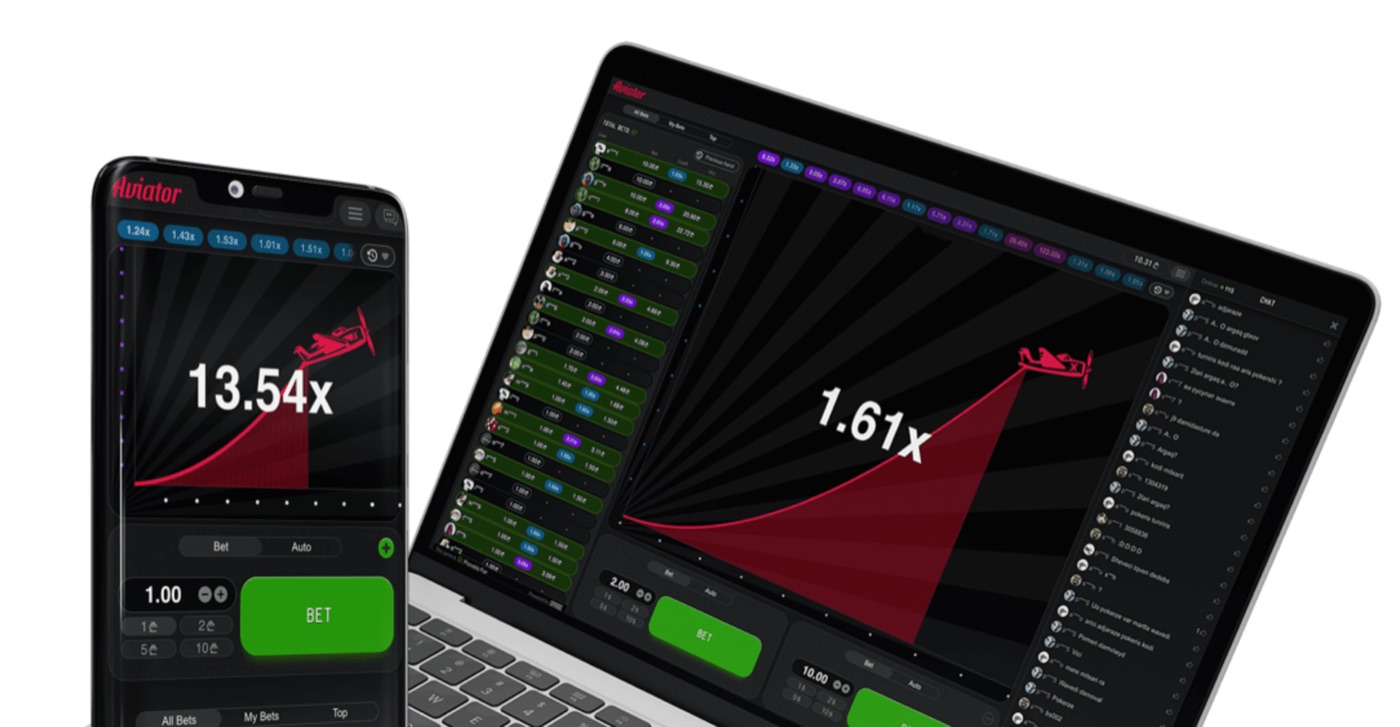
Separate screens show a high multiplier and a lower cash-out target.
A two-bet split places one part of the bankroll at a lower target and another part at a higher target. The lower bet may cash out more often, while the higher bet is exposed to more early crashes.
- Low target: commonly 1.5x or 2x.
- High target: commonly 5x to 10x.
- Lower target: more frequent successful cash-outs.
- Higher target: less frequent successful cash-outs.
- Both targets: subject to the same 3% house edge.
For example, a player can put 70% of the round’s planned stake on a 1.5x auto cash-out and 30% on a 5x auto cash-out. If the round reaches 1.5x but stops before 5x, the first bet wins and the second bet loses.
A different split can use equal stakes on both panels. Equal stakes make the two targets easier to compare, while an unequal split gives greater weight to the selected priority. The choice controls exposure and variance rather than the underlying edge.
Probabilities And Returns
Aviator’s probability of reaching multiplier m is 0.97 divided by m. The probability of an instant crash at 1.00x is about 3%, or roughly 1 in 33 rounds.
At every cash-out target, the expected value is minus 3% of the stake. A target therefore changes the frequency and size of wins, but it does not create a positive expected return.
| Target | Chance of reaching it | Gross return on a winning bet | Result pattern |
|---|---|---|---|
| 1.2x | 80.8% | 1.2 times the stake | Frequent smaller wins |
| 1.5x | 64.7% | 1.5 times the stake | More frequent than 2x |
| 2x | 48.5% | 2 times the stake | About half of rounds |
| 3x | 32.3% | 3 times the stake | Less frequent wins |
| 5x | 19.4% | 5 times the stake | High variance |
| 10x | 9.7% | 10 times the stake | Infrequent large wins |
Suppose a player stakes one unit at a 1.5x target. The bet returns 1.5 units when the target is reached, including the original stake. The probability and payout combine to produce an expected return of 0.97 units, which is a net expected loss of 0.03 units.
The same calculation applies to a 5x target. The chance is lower, but the payout is higher. The expected return remains 0.97 units per unit staked, before considering any operator-specific rules.
- At 1.2x, the chance is 80.8% and the house edge remains 3%.
- At 2x, the chance is 48.5% and the house edge remains 3%.
- At 5x, the chance is 19.4% and the house edge remains 3%.
- At 10x, the chance is 9.7% and the house edge remains 3%.
For a split, calculate each part separately. If 0.7 units are assigned to 1.5x and 0.3 units are assigned to 5x, the combined expected return is 0.679 units plus 0.291 units, or 0.97 units from one unit staked.
Bankroll Limits And Automation
Strategy guides commonly recommend staking no more than 2% of the bankroll per round. Aviator includes Auto Cash-Out and Auto Bet or Auto Play settings for 10-100 rounds.
The Auto Cash-Out setting closes a bet at a preset multiplier. Auto Bet or Auto Play can include stop-on-win and stop-on-loss settings, but automation does not alter the 97% RTP or the 3% house edge.
- Set the total amount for one round before selecting targets.
- Keep the total round stake within the chosen bankroll percentage.
- Assign the larger share to the lower target only if lower variance is the priority.
- Set a stop-on-loss level before starting an automated sequence.
- Set a stop-on-win level before starting an automated sequence.
Consider a bankroll of 100 units and a 2% round limit. The total stake for one round would be 2 units. A 70/30 split would assign 1.4 units to the low target and 0.6 units to the high target.
At 1.5x, a winning 1.4-unit bet returns 2.1 units. At 5x, a winning 0.6-unit bet returns 3 units. If both targets are reached, the total return is 5.1 units against a 2-unit total stake.
If only 1.5x is reached, the first return is 2.1 units and the 0.6-unit high-target stake is lost. If the round crashes below 1.5x, both bets lose. These outcomes show why the split changes result variation rather than expected value.
Martingale doubles the stake after each loss and reaches 1,024 times the base stake after 10 losses. Fibonacci and D’Alembert systems also do not overcome the 3% edge.
- Do not increase the stake because a previous round lost.
- Do not treat a recent sequence as a prediction signal.
- Do not use a higher target to recover an earlier loss.
- Stop when the preset loss limit is reached.
A player comparing a bookmaker’s crash-game stake and cash-out options may see 1win aviator apk download mentioned in gambling discussions, but the link does not change Aviator’s multiplier probabilities.
Worked Bankroll Split
Aviator offers two bet panels in each round, so one round can contain a 1.5x bet and a 5x bet. A 100-unit bankroll with a 2% limit gives a total round stake of 2 units.
A 70/30 allocation gives 1.4 units to the 1.5x target and 0.6 units to the 5x target. The example shows cash-flow outcomes, not a method for predicting the next crash point.
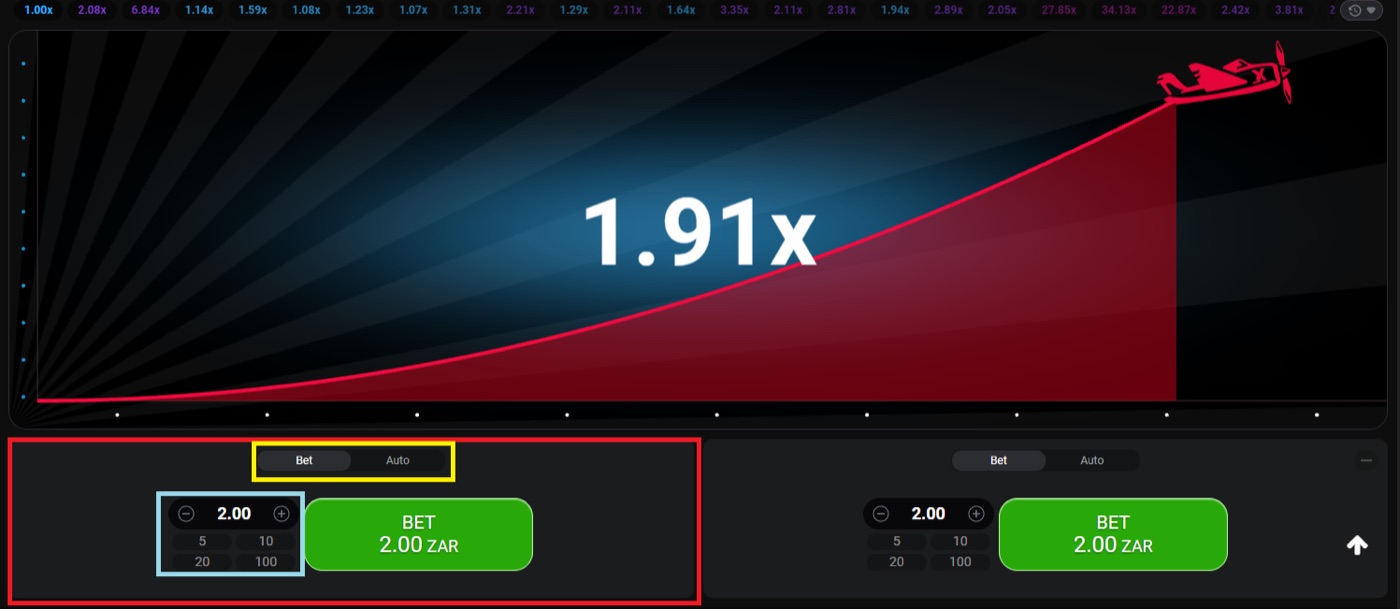
Two bet panels allow separate stakes and cash-out targets in one round.
| Round result | Low-target bet | High-target bet | Total return | Net round result |
|---|---|---|---|---|
| Below 1.5x | Lose 1.4 | Lose 0.6 | 0 | -2 units |
| 1.5x to below 5x | Return 2.1 | Lose 0.6 | 2.1 units | +0.1 units |
| 5x or higher | Return 2.1 | Return 3 | 5.1 units | +3.1 units |
The middle result can produce a small net win because the low target uses most of the stake. The first result loses the full 2 units, while the third result produces the largest return.
The probability of reaching 1.5x is 64.7%. The probability of reaching 5x is 19.4%, so the high-target bet will lose more often than it wins. The exact combined distribution depends on how the two stakes are split.
- Choose a total round amount.
- Choose the lower target.
- Choose the higher target.
- Divide the amount between the two panels.
- Record the result without changing the next stake because of it.
A 50/50 split would make the high target more influential. A 90/10 split would reduce the high-target exposure. Neither split changes the expected loss rate of 3% on the total amount staked.
Fairness And Practical Limits
Aviator publishes a SHA-256 hash of the server seed before each round. Player client seeds are combined with the server seed, and the inputs can be checked with the verification tool inside the game after the round.
Rounds are independent, and the crash point is committed before take-off. A hash system confirms the result process, but it does not make a high target more likely.
The game runs inside an operator’s website or app, and there is no standalone official Aviator app from Spribe. Stakes commonly range from about $0.10 to $100 per bet, but the available range depends on the operator.
- Win caps per round depend on the operator.
- Minimum and maximum stakes depend on the operator.
- Cash-out requests must reach the server before the crash.
- Latency or a slow device can cause a cash-out time-out.
- Off-peak play may provide a smoother connection, not better odds.
The maximum multiplier is not published by Spribe, and guides quote different figures. A high target should therefore be treated as a high-variance choice rather than a guaranteed destination.
Previous multipliers, graph analysis, patterns, strategy charts, and claims about the best time to play do not change the odds. Prediction is impossible because the crash point is committed by hash before the round begins.
Play only with money you can afford to lose, and keep a fixed loss limit.
Aviator FAQ
Aviator is a crash game developed by Spribe and launched in early 2019. Its 97% RTP means the expected loss is 3% of the stake over time.
The game supports two bet panels with separate cash-outs. This allows players to compare a low target and a high target within the same round, without changing the game’s probabilities.
Does splitting the bankroll beat Aviator’s edge?
No. The expected value is minus 3% of the stake at every cash-out target. Splitting the bankroll changes variance and the timing of wins and losses, but it does not remove the house edge.
What is a low Aviator target?
A low target commonly means 1.5x or 2x. Aviator reaches 1.5x in about 64.7% of rounds and 2x in about 48.5% of rounds.
What is a high Aviator target?
A high target can mean 5x or 10x. Aviator reaches 5x in about 19.4% of rounds and 10x in about 9.7% of rounds, so these targets have higher variance.
Can an Aviator app predict the crash?
No. There is no standalone official Aviator app from Spribe, and prediction is impossible because the crash point is fixed by the provably fair process before take-off. Third-party predictor apps and signal bots do not change the result.
Why did an Aviator cash-out time out?
A cash-out request must reach the server before the crash. Latency or a slow device can cause a time-out, and the displayed result cannot be changed after the round starts.
Can Aviator be played for free?
Yes. Demo mode exists through an operator demo or demo.spribe.io and needs no registration. The demo mode does not change the probabilities or provide real-value winnings.